1To improve search visibility, focus on answering the reader’s next question rather than increasing your word count.
2Write local business posts as decision guides that reduce uncertainty before a visit.
Y
About the author
Yongwoon LeeContent Lead, Cresco
At Cresco, designs how blog, local listing and Instagram content is run for clients such as clinics, and plans and reviews the articles on this blog.
Small-business marketing · SEO · AI search (GEO) · Naver Place · Content strategy
Frequently asked questions
Do blog posts always need to be long?+
No. Information that matches search intent matters more than length. But a very short local business post may lack the context readers need to decide whether to visit.
Will adding lots of photos help increase time on page?+
Repeating similar photos has limited value. Photos that answer different questions—about the menu, seating, entrance, parking, or takeout—are more useful.
How many times should I use a keyword?+
Natural context matters more than a fixed count. Work the language your customers search for naturally into the title, opening paragraph, and body.
Should I avoid short announcement posts?+
No. Short posts are useful for closures, promotions, and new menu items. Posts intended to attract search traffic should also explain who a visit suits and what readers need to make a choice.
3Open with who the business suits and the key answers, put selection criteria in the middle, and finish with practical details such as reservations, parking, and takeout.
4Use photos to answer different questions—show the menu, seating, entrance, and directions instead of repeating decorative shots.
5Replace repeated keywords and sales copy with guidance on trade-offs and when your business is a good fit.
6Present information in the order readers need it instead of trying to artificially increase time on page or scroll depth.
Blogs that rank well give readers a reason to keep reading. Length alone does not make them effective. When a small business post stops after listing the menu, prices, and location, search engines have fewer opportunities to observe signs of reader satisfaction.
Naver Search Advisor, the search guidance resource from South Korea’s Naver search engine, describes useful information and clear document structure as foundations of search-friendly content. A local business post should help people decide whether to visit.
Time on page is more about satisfaction than length
Time on page is the amount of time someone spends reading a post. A higher word count does not automatically make that time a positive signal.
What matters is how well the answers match the reason someone searched. A person looking for a “kid-friendly restaurant,” for example, may spend more time reading about space between tables, high chairs, spice levels, and access from the parking lot than a general menu introduction.
Short posts leave little room for these decision-making details. People often have unanswered questions before visiting a local business. If a post ends too quickly, they are more likely to return to the search results.
Scroll depth puts your post’s structure to the test
Scroll depth shows how far down a page a reader goes. If the opening screen offers only sales copy and another showcase photo, readers lose their reason to scroll.
A blog post should set expectations at the top, help readers compare their options in the middle, and organize practical next steps at the bottom. That progression gives readers a natural reason to continue.
Table: Short promotional posts vs. posts built to keep readers engaged
Element
Short promotional post
Post built for reader engagement
Opening screen
Business introduction and feel-good copy
Key answers that match the search intent
Middle
A series of photos
Guidance for different needs and situations
Bottom
Address and contact details
Reservations, parking, and reasons to return
Reader behavior
More likely to leave quickly
More likely to read and compare
The goal is to arrange information in the order people are likely to ask for it. Each paragraph should give them a reason to read the next one.
Organize local business posts around the customer’s visit
A common problem with small business posts is that owners and customers want information in different orders. Owners want to lead with new menu items, promotions, and atmosphere. Customers first want to avoid a disappointing visit.
Promotional material is reorganized around why customers are visiting and what they need to make a choice.
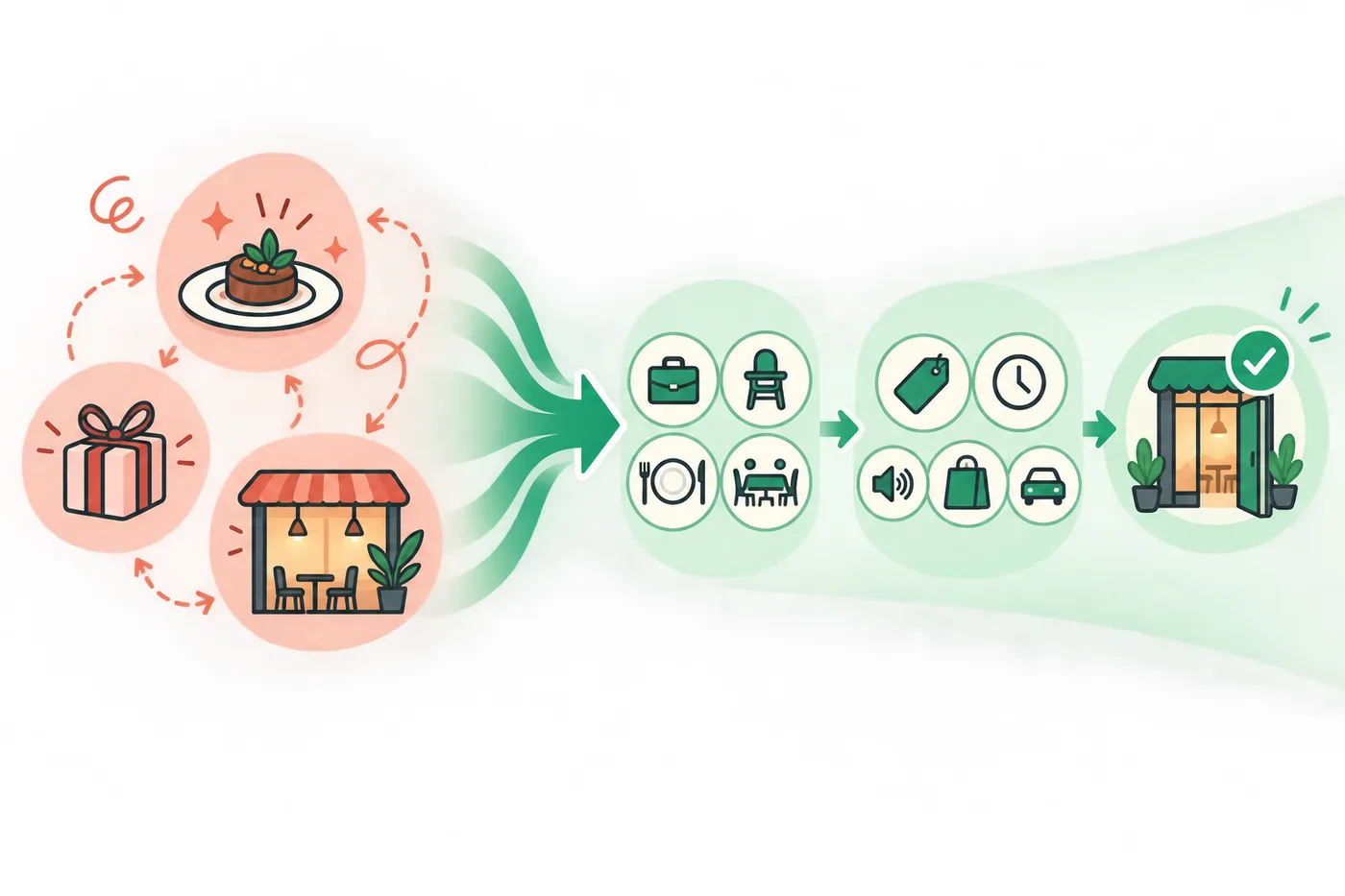
Start by explaining who the business is a good fit for. Giving the visit a clear context—an office lunch, a family meal with children, dining alone, or a team dinner—creates a reason to keep reading.
Use the middle of the post for practical selection criteria. Price range, possible wait times, quieter hours, suitability for takeout, and ease of parking may seem like small details, but they can determine a customer’s choice.
Give every photo a role in the reading experience
Photos set the pace of a post as well as making it attractive. Repeated food shots from the same angle encourage faster scrolling while adding little information.
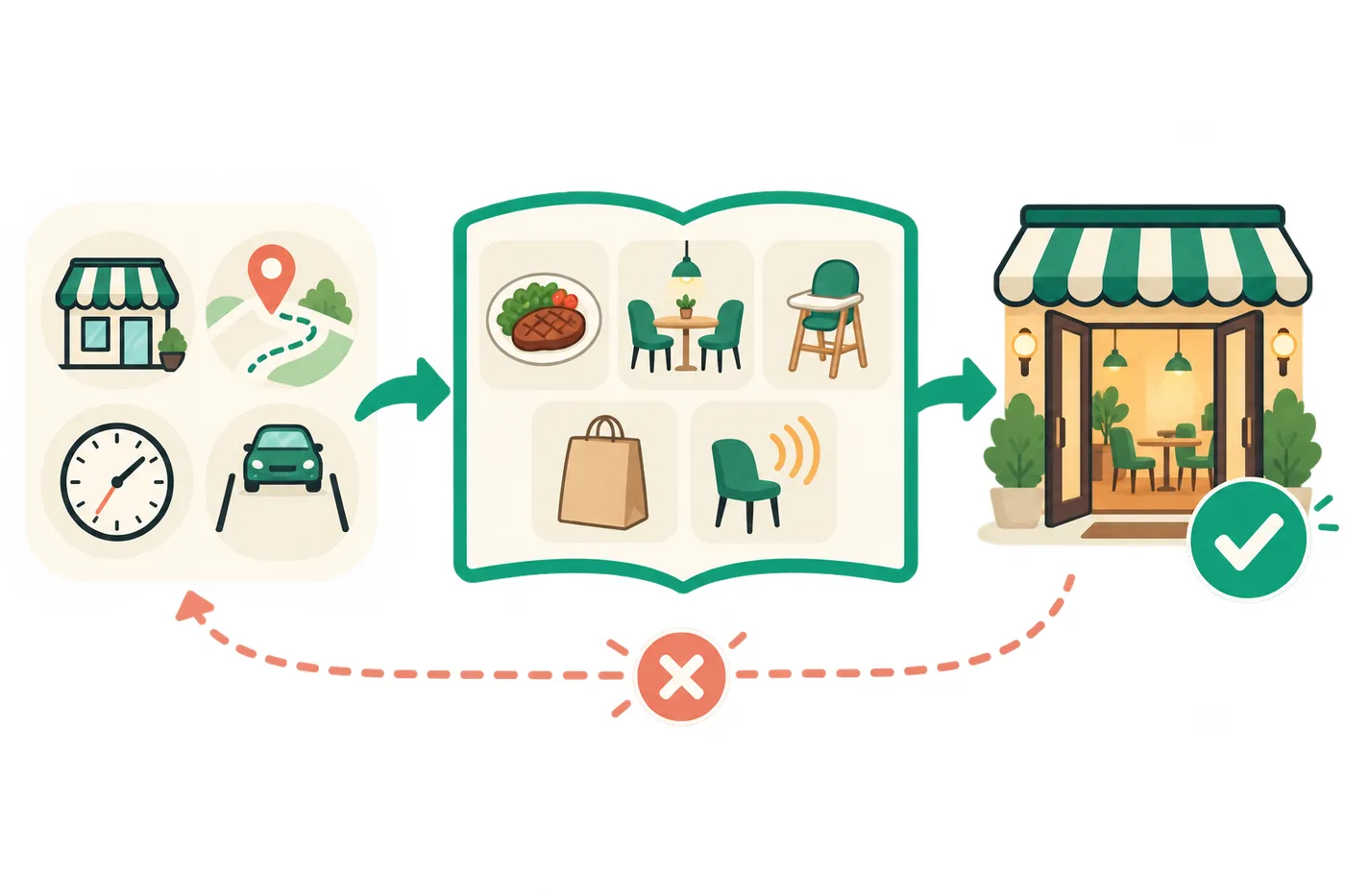
A local business blog needs photos that answer different questions: a showcase image, the menu, seating, the entrance, the route from a nearby street, and how takeout is packaged. Each image should give readers something different to check.
Organizing content ideas across channels also makes it easier to build a library of blog posts that match search intent and retain value beyond a single promotion.
Table: A framework for blog sections that keep readers engaged
Position
Reader’s question
Information to include
Top
Is this a good fit for me?
Reasons for visiting, main strengths, and key differences
Middle
How does it compare with other options?
How to choose from the menu, value for money, and suitability for different occasions
Bottom
Can I visit now?
Hours, reservations, parking, takeout, and reasons to return
High-ranking posts offer more guidance than sales copy
Repeating keywords excessively does little to make a blog post worth reading. Searchers want evidence that helps them judge whether a business suits their needs.
Basic business information combines with guidance relevant to the customer’s situation to support a visit decision.
For example, “The broth is rich, so it may feel a little heavy for lunch” gives readers more to consider than “It’s delicious.” Explaining when a strength might suit someone—and when it might not—makes the information more credible.
Naver SmartPlace, a Korean business listing service similar to Google Business Profile, and a blog may look like separate channels. In the customer’s search journey, they connect. The listing establishes basic trust, while the blog supplies more reasons to choose the business.
Brief posts are harder to build on over time
For small businesses, a blog post can become source material for search traffic, map searches, review management, and Instagram content. Its usefulness can extend well beyond publication day.
Publishing only short announcements limits how much value accumulates from that effort. Detailed posts built around different reasons for visiting provide copy and photos that are easier to reuse across other channels.
Planning for time on page means organizing a post to answer customers’ pre-visit questions in sequence. It is an editorial approach to making the visit decision easier.
The strongest search-focused blogs give readers enough useful information to stop looking elsewhere. That is why a local business post needs room to answer the questions that matter.